The Constitution
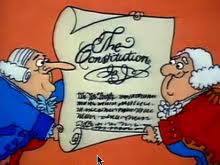
The Constitution
Wednesday, August 29, 2018


Friday, May 26, 2017
The Gettysburg Address
Today, we will be learning about perhaps the greatest presidential speech of all time. Click on the link to start the lesson: The Gettysburg Address
Thursday, May 25, 2017
Civil War Simulation
Today we will begin our study of the Civil War. First, you will click on the first link below to play a simulation where you make decisions as either a member of the Union or of the Confederacy. When you have completed the simulation, click on the second link to a Google Doc that you will copy to your account. Complete this document of the major Civil War battles.

Wednesday, May 24, 2017
Thursday, May 11, 2017
Civil War Newspaper
 Civil War Newspaper Assignment
Due May 23rd
This project is worth 40 pts.
Imagine that you are a reporter during the Civil War. What kind of writer would you be? What type of things would you like to write about? In this assignment you will write as if you were a reporter during the War. First, you have to decide if you will be writing from the perspective of a Southerner or a Northerner. Then you have to give your newspaper a name such as the “Gettysburg Gazette”. Your newspaper will contain at least four articles and you can choose any event that occurred between the years 1860-1865 in American history. You need to write the articles as if the events you described happened just a few days ago. Each article should be a minimum of 100 words.
 Your grade will be determined by how well you describe the events, how many details you provide in your articles and the thoroughness of your research. Each article should also have a headline. Grammar, spelling and punctuation errors will result in a loss of points for each individual article.
There should be no excess white space in your newspaper. You should include pictures with captions, political cartoons, advertisements, etc. to complete your newspaper. All pictures, political cartoons, advertisements, etc. must be relevant to the time period.
The newspaper must be done on the computer. You will assemble your newspaper using Google Docs.
You must use at least 3 resources other than your textbook for the newspaper. Internet sources are acceptable as long as they come from reputable academic sites and are properly cited. (Do not cite Wikipedia as a source) Each article that you write should have a live link that I can click on to see the source.
THE ARTICLES MUST BE IN YOUR OWN WORDS. DO NOT COPY AND PASTE TEXT INTO YOUR WORK WITHOUT GIVING PROPER CREDIT TO THE AUTHOR. It helps to write the article with a biased view (Northern or Southern). Quotes are great, just make sure they are in quotation marks and that you have cited the source in the article.
ARTICLE #1 – A NEWS STORY: Your first article will describe a major event from the War. Give specific details from the event and make sure that you include all of the important points about the event. You need to give information on the background of the event so that the reader will understand what led up to the event.
ARTICLE #2 – A NEWS STORY: This article is the same as the first. Just describe an event that happened around the same time as the first event. If you want to you can write a story that is related to the first. For example, the battles of Gettysburg and Vicksburg occurred at the same time. Your first story could be about Gettysburg and the second about Vicksburg. Or you could write about the Battle of Antietam in your first article and you can write about the Emancipation Proclamation for your second article.
ARTICLE #3 – SPECIAL INTEREST STORY OR A BIOGRAPHY: This article is about an individual that is directly involved in the War. You can write about a real person such as Robert E. Lee or U.S. Grant or you can make up a fictional character such as a Union or Confederate soldier. If you choose to write about a real person you need to include details about their background such as where they were born, where they were educated and how they got involved in the war. You need to include details about the role they played in the war and the impact they had on the outcome of the war. If you choose to do a fictional person you also need to give details about the background of the individual and create a plausible reason for that person to be involved in the war. Although this person is made up, you need to give details about real events that your fictional person might have been involved in.
ARTICLE #4 – EDITORIAL: This article is an editorial. That means you need to pick a controversial topic and give your opinion on the topic. You should write this article in the first person and in such a way as to persuade the reader to see things the way you do. If you think that the North should let the South secede with fighting, talk about how costly the Civil War is in terms of both money and lives. Talk about how hard it would be to reconcile with the slave owning states after the war was over. Like all the other articles you need to include historical facts in your editorial.
Newspaper example from my class
Wednesday, May 10, 2017
Causes of the Civil War Test
After you finish the test today, please go to the following link: HS Transition Survey
When finished with the survey, please watch: Crash Course: The Civil War
When finished with the survey, please watch: Crash Course: The Civil War
Tuesday, April 25, 2017
Flight to Freedom
Today you will begin an interactive game called "Flight to Freedom".
Click on the link to begin the lesson: Flight to Freedom
Click on the link to begin the lesson: Flight to Freedom
Subscribe to:
Posts (Atom)