The Constitution

The Constitution
The Constitution

Monday, January 24, 2011

The Constitution


If you did not finish Friday's assignment, be sure to do so before moving on. Remember, you had a film, a scavenger hunt, and the Constitutional Convention Rags to Riches game to complete. Show the substitute teacher when you have completed one of these assignments.


When you are finished, follow these instructions:

1) Find the School House Rock section of the blog and click on the Preamble. You will be asked to memorize the Preamble, and write it on the Constitution test. Learn the song, sing it, commit it to memory. It helps to look at the words while you watch the video. Under the video, you will see a place that says lyrics. Click on it and you will see all of the words to the Preamble as you listen to the song. The only difference in the song and the actual preamble is that the song leaves out the phrase "of the United States" after We the People...


2) Under formative assessments you will see a We The People Puzzle. Complete the puzzle.

Show the substitute. You can use your textbook to complete the puzzle, or just do a google search for preamble to the Constitution.

3) Continue to listen to the video, and working on the puzzle, until you can complete the puzzle without looking at the preamble.

Friday, January 21, 2011

Constitutional Convention Scavenger Hunt!


Click on the title of today's blog to complete the scavenger hunt.

When finished with the Scavenger hunt, you may watch the Liberty's Kids film below:

Tuesday, January 18, 2011

Shays's Rebellion


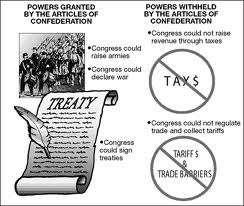
The Articles of Confederation created a weak central government. Under this system, the national government could not force states to pay taxes. As a result, it began printing money, lots of money to pay debts owed to foreign nations. The over printing of money led to inflation. Soon, many people refused to accept paper money for payment of debts, because it was not worth anything.

In Massachusetts, a law was passed that required all debts to be paid in gold and silver rather than paper currency. Farmers who did not have gold soon began to lose their farms when they could not pay for their farm loans. When the banks began foreclosing on farms across the state, Daniel Shays, and many of his neighbors, began attacking the courts to stop the foreclosures. Eventually, they made their way to the Massachusetts state house in Springfield. When the state asked the national government for help, they received none, because the government under the Articles of Confederation did not have the power to raise an army for defense.

Daniel Shays's rebellion was eventually put down by the Massachusetts militia, but throughout the 13 states, it was clear that changes needed to be made. Each of the states were experiencing the same type of financial problems as Massachusetts.
Today, we will take a look at the weaknesses of the Articles of Confederation, and begin some Constitutional Vocabulary. If you are at home, define or identify the items listed below using your textbook or any other resource you have available. These are due on Friday.

constitution
republicanism
limited government
suffrage
ratification
Articles of Confederation
Land Ordinance of 1785
Northwest Ordinance of 1787
Northwest Territory
tariffs
interstate commerce
inflation
debtors
creditors
depression
Shays's Rebellion
Daniel Shays
popular sovereignty
federalism
legislative branch
executive branch
judicial branch
checks and balances
Constitutional Convention
James Madison
Virginia Plan
William Patterson
New Jersey Plan
Great Compromise
Three-Fifths Compromise
amendments
Anti-federalists
George Mason
Federalists
Federalist Papers
Bill of Rights


Wednesday, January 12, 2011

Articles of Confederation


Use the excerpts from the Articles of Confederation below to answer the questions that follow.


Articles of Confederation excerpts:

Article V.

...No state shall be represented in Congress by less than two [members], nor by no more than seven members;...

...In determining questions in the United States, in Congress assembled, each state shall have one vote....

Article VIII.

...All charges of war, and all other expenses that shall be incurred for the common defense or general welfare and allowed by the United States in Congress assembled shall be defrayed out of a common treasury, which shall be supplied by the several states,...

...The taxes for paying that proportion shall be laid and levied by the authority and direction of the legislatures of the several states within the time agreed upon by the United States in Congress assembled....

Article IX.

The United States in Congress assembled shall never engage in a war, nor grant letters of marque and reprisal in time of peace, nor enter into any treaties or alliances, nor coin money, nor regulate the value thereof, nor ascertain the sums and expenses necessary for the defense and welfare of the United States, or [of] any of them, nor emit bills, nor borrow money on the credit of the United States,...

...unless nine states assent to the same; nor shall a question on any other point, except for adjourning from day to day, be determined unless by the votes of a majority of the United States in Congress assembled....

Remember that the term "articles" means parts or provisions of a document. Answer the following questions using the excerpts of the Articles of Confederation. The answer can be found in the article listed for each question.

1. Article V

a. How many delegates to Congress could each state have?
b. How many votes did each state have?

2. Article VIII

a. Where would Congress get money to run the country?
b. How would this be enforced?

3. Article IX

a. What were the powers of Congress that were limited in this excerpt of Article IX?
b. What was necessary for Congress to pass legislation?

Use your textbook or other resources including the Articles of Confederation to answer the following questions.

4. Discuss three lasting achievements of the federal government under the Articles.

5. Throughout history, territory was usually added to a nation by conquest and treated as conquered land. Explain how the provisions of both the Land Ordinance of 1785 and the Land Ordinance of 1787 (Northwest Ordinance) together provided the means for territory to be added as equal states to the new nation. Refer to a map showing the Northwest Territory to get a visual image for preparing your answer.

Find a map, and information about the Northwest Ordinance in chapter 8 of your textbook.

6. Make a list of at least four problems the national government experienced under the Articles of Confederation. For each tell why the national government had difficulty in conducting business.

When finished with assignment, watch the following film about the early years of the United States under the Articles of Confederation.


State Constitutions


Today, you will finish your state constitution. Make sure that you have placed limits on your government. It helps to imagine that whomever you place in the government will eventually attempt to abuse the power he or she has been given. Plan for this, and you will be able to set limitations on your government. A constitutional government is first, and foremost, limited in its power. Remember, every government has three jobs: make laws; enforce the laws; and decide who may have broken the laws and how they will be punished.

Friday, January 7, 2011

The Constitution

This week we will start my favorite part of our curriculum- the U.S. Constitution. Knowledge of our government and how it operates is an integral part of being an American. Our Founding Fathers believed from the beginning, that citizens would need to be educated properly in government and history in order to participate in our federal system. Indeed, it was their knowledge of world history and political philosophy that led them to design a new style of government.

Before we can begin our study of the Constitution we will need to discover why they designed this particular type of government ... and how!

Today you will create a state constitution. I will give you a hand-out with steps to follow. You will log on to Google Docs and work with up to 2 people (besides yourself) in this class period. Make sure you share your work with me.

Thursday, January 6, 2011

American Revolution Test


Click on the title of today's blog to take the test. Good luck!

You may take it more than once during this class period.

When you are finished, you may read a book, work on an assignment from another class, or do anything linked to my blog page.

what happens when I add something???